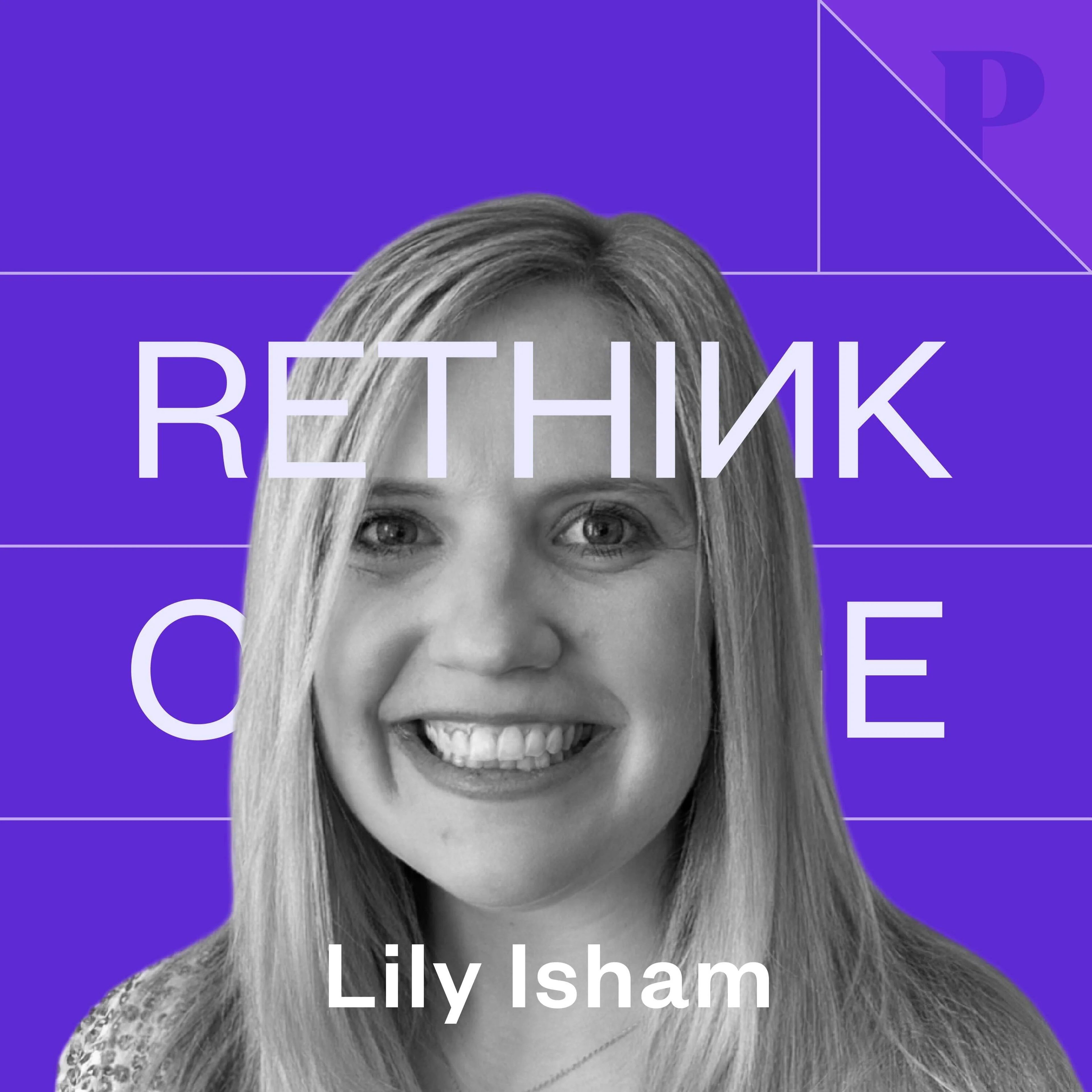
22 — Finding Opportunity in Every Corner with Lily Isham, General Manager, Financial Solutions at Conduent
What does it really take to simplify complex systems in a world where financial services, customer expectations, and technology evolve faster than most teams can keep up? And as AI unlocks real-time insights and new opportunities, how do leaders balance speed, strategy, and the courage to rethink what’s always been done?
Shownotes
Things to ponder
What does it really take to simplify complex systems in a world where financial services, customer expectations, and technology evolve faster than most teams can keep up? And as AI unlocks real-time insights and new opportunities, how do leaders balance speed, strategy, and the courage to rethink what’s always been done?
This episode explores the mindset required to navigate change, spot hidden opportunities, and build teams capable of challenging assumptions to move an organization forward.
In this episode of Rethink Change, Lily Isham, General Manager, Financial Solutions at Conduent, explains how understanding the full process gives leaders the power to simplify it, move faster, and create better outcomes for both clients and employees. She takes us inside the evolving world of financial services, where customer expectations shift overnight, and AI offers unprecedented clarity through real-time data.
Lily also reveals how generalists uncover hidden opportunities, why hiring people who think differently expands your blind spots, and how due diligence builds the credibility needed to drive meaningful change. Her story is ultimately about embracing constant evolution and learning to see change not as a disruption, but as your most reliable competitive advantage.
Lily Isham is an adaptable and results-driven general manager who leads two software businesses managing technology, data, and client outcomes. Currently overseeing an $80M portfolio at Conduent—including Legal eDiscovery, Cyber Data Triage, and Loan Servicing—Lily oversees all financial management, product, go-to-market strategy, and operational scale across industries, including banking, automotive, law firms, and start-ups.
Her leadership also includes large-scale transformation, project and portfolio management, global operational teams, and complex cross-functional initiatives. Lily has a proven track record of developing and executing strategic initiatives that unlock savings, new revenue streams, expand partnerships, and accelerate product innovation in CX, Financial Services, and Government.
- Resources
- Find Lily on LinkedIn
- Chapters:
- 00:00 - Intro to Guest: Lily Isham
- 01:17 Understanding Conduet and Lily’s Role in Supporting This Industry
- 02:37 Challenges in Financial Services and Customer Expectations
- 05:03 Simplifying Complex Processes
- 07:29 Different Types of Competitors and Secret Sauce of Conduet
- 10:14 The Value in Being a Generalist and Finding Opportunities
- 17:43 Navigating Change and AI Implementation
- 21:43 Leadership and Team Dynamics
- 28:29 The Major Differences Between Mentorship and Sponsors
- 31:25 Final Thoughts on Value Proposition and Relevant Branding
Transcript
[00:00:00] One of the things that I've done as I've approached new opportunities is evaluate how much you can learn in the opportunity and evaluate the opportunity. Based on that. There's gonna be some change you can influence and there's gonna be some change that you need help to be able to drive. You might as well get comfortable accepting and adapting to the change because it's gonna happen anyway and you are gonna be a lot happier as an employee or as a leader if you figure out how to. Quickly adapt to the change then as somebody who fights the change.
Matt Pennebaker:[00:00:43] Today in Rethink Change, I'm thrilled to welcome Lily Isham, general Manager of Banking and lending at Conduit in most recently platforms, with more than a decade of experience reshaping banking operations, guiding product roadmaps, and driving client innovation across global financial services industry. Lily brings a rare blend of strategic thinking and hands-on execution. Lily, welcome to Rethink Change.
Lily Isham:[00:01:07] Thank you. Thanks, Matt. Thanks. We're very happy to be here today and I appreciate you guys, uh, setting me up to get connected here.
Matt Pennebaker:[00:01:16] Absolutely. So I, I guess for starters, for our listeners out there, help me understand what conduit is and really what industry you're serving.
Lily Isham:[00:01:25] Absolutely. So Conduent is a business process outsourcing company. And so similar to really large business outsourcing companies like an Accenture, Conduent support organizations, um, and helps 'em get back to focusing on what their core value is to their constituents. So for example. Um, instead of a smaller company taking on finance, accounting, and procurement, conduit would take that on for a particular client organization. A lot of our businesses, contact centers globally and I ran a couple of different businesses targeting financial services company.
Matt Pennebaker:[00:02:04] You kind of have a unique role over there. You know, you sit at the apex, or at least your career does a finance and technology and operations for a company's largest conduit. And how, how many employees do you have these days? About 20,000 or so,
Lily Isham:[00:02:18] 60,000. Um, 60. Yeah, so a lot of those associates are supporting our clients, but still a huge footprint across 20 countries.
Matt Pennebaker:[00:02:29] So you have a lot of discussions around transformation across, you know, the FinTech and banking operations and regulatory pressures, outsourcing, et cetera. So what are, what are the biggest challenges that you face in the organization?
Lily Isham:[00:02:40] Yeah, I think that there's two sides of it that I like to think about. One of which is how does Conduent support its own mission and support its own shareholders, as well as how do we support our clients and their challenges? And so because my clients we're focused in the financial services industry, they're facing a lot of challenges in terms of customer expectations, so banks and financial services. Tend to be very risk averse organizations, but their customer experience and the ease of doing business for those companies is compared to the leaders in customer experience globally. So think about doing business with Amazon, doing business with Apple, versus doing business with a large top five bank. And so, um, one of the things that they really struggle with is how do we. Improve our customer experience across legacy, very dated, siloed systems and technologies, while ensuring that we're also maintaining regulations. So one of the things that we think about in that sense, and one of the things that we like to do when we talk to clients about this, is the number one thing, the most important thing you do is you, you have to understand the process. And if you understand the process, then generally speaking, you can have opportunities to simplify the process. So in a Lean Six Sigma. Perspective, you eliminate the waste. And from there, as you start moving into the maturity of the process, you can start really understanding what are the pain points from a customer perspective in the process. So where does your customer experience friction that you need to resolve for them? And then once all that's figured out and you really have given dove deep into this process, then you can look at. Some of the fun, you know, sexy things that we like to talk about in transformation, right? You could talk about ai, you can talk about automation. Um, we also talk about, you know, follow the sun processing so you know, your teams are working 24 7. And those are really the, the challenges that my clients are up against. Um, and trying to figure out how do we. Begin to simplify these processes for them, their employees, as well as their clients.
Ward Pennebaker:[00:05:03] Can you give us an example of one that was particularly complex that you simplified?
Lily Isham:[00:05:09] One of the things that you have to think about is when your clients are getting involved or doing any type of what we would call. Processes that are kind of like ancillary to their, the support of their system. And so one of the processes that we looked at for a large bank was basically providing personal information to ensure that the bank could meet anti-money laundering requirements. So the banks have to do sanctions, tracks, things like that. And so one of the problems that this one particular client was running into was that they had a bunch of clients in all different regions within Europe, across a bunch of different languages. This was about four years ago, the time language translation that we have today. And so what this client ended up having to do was an outbound campaign hire contact center associates in this different processes. And they, believe it or not, would mail out paper information and tell clients to call to correct it. So as you can imagine, this process for the client's was miserable. You get something in the mail. You have to call somebody to get it updated. Hopefully they speak your version of Swiss German at this particular time that you're calling, and then you keep on getting it. And sometimes if they don't get the right information, they, we lock down your account. So what we were able to do, as you can probably imagine for those of you in the, our day and age, we created an online portal. So this online portal pushed them information. They had to go in and verify these public records. They had to do a not authentication based on public information. So they could say, you know, for example, Lily Isha, do you currently live at X, Y, Z address or have you lived or this address? And then at the end of it, it would confirm, you know, correct their information. So we took a highly manual process that involved. Physical paper contact center agents in various countries within Europe in particular in this experience. And then we were able to fully digitize the experience. And so the only time somebody was calling in was if they didn't understand it or they couldn't access the portal.
Matt Pennebaker:[00:07:28] Interesting. Who are your closest competitors in this space? I mean, is it like the Accenture's of the world or is it a DP or, or the status quo of inertia?
Lily Isham:[00:07:37] One of the, uh, complexities and nuances is, depends on the business unit, depends who our comp, uh, competitors are. So Accenture is helpful because they're huge competitor, but they're also probably one of the best known BPOs in the space. However, if you look specifically at bank and lending services, so this. Business where I run, we would be competing with Deluxe. We're competing with Fiserve, um, on a smaller scale. Um, we're also competing with Defy. There are niche competitors in each of our lines of business that specialize in one of the various things that we do. But very few competitors in our industry have the breadth. That conduit can bring to support the clients.
Matt Pennebaker:[00:08:22] So what, what would you say your secret sauce is then? You know, because you've got the big mega competitors like the Accentures and you know, obviously your niche regional players are I, I guess not so regional, but what really sets you apart?
Lily Isham:[00:08:34] It's a great question and I think we continue to try to refine. How we talk about this and what does it look like for our organization. But, uh, in my mind, what the way I talk to my clients about it is we have the expertise of these niche players and the industry depth, the knowhow, but at the scale where we can bring. A thousand contact center agents in six months for whatever project you need globally across 20 countries. We're able to feel a little bit like a small startup in terms of how depth, our depth of expertise, but we still have that broad brush scale, um, that gives you the flexibility to, to do whatever you need to do.
Matt Pennebaker:[00:09:17] Do your customers really understand your differentiated value compared to the Pfizer, to the Accenture's or the other competitors that, that you're facing in the marketplace?
Lily Isham:[00:09:26] I think it depends on the client. Certainly our clients that work with us across multiple products understand our differentiated value proposition. But any mid-tier client, certainly not. And we as an organization are trying to get a lot better at telling that story and making sure they understand that we are not just in their industry, we're in many industries. And have many products that can support their their needs.
Ward Pennebaker:[00:09:58] What would you tell somebody who says, boy, what you do sounds interesting. How can I get into that?
Lily Isham:[00:10:03] If somebody wants to get into it, I think the first thing you need to do is go out and talk to people who are in it. Hit up your LinkedIn contacts, um, and see, the other thing is there is some value in being a generalist and so not doing any one thing for any one company. Which can sometimes be hard to do professionally and you sometimes get pressure professionally to, to do that. One of the things that I've done as I've approached new opportunities is evaluate how much you can learn in the opportunity and evaluate the opportunity based on that personal and professional growth. Um, and that was how I decided to move into outsourcing.
Ward Pennebaker:[00:10:45] I'm really interested in, uh, where you came from and what you thought you were getting into when you came, your, your job, and, uh, what surprised you most and what was. My job at Conduent. Mm-hmm.
Lily Isham:[00:10:59] Yeah. So, um, I didn't really know, I don't think what I was getting into, so I really moved to Conduent to accelerate my career. I felt like I could do more for an organization and learn a lot quicker in a less structured environment than I could at a, an organization that. I know many people worked at for 20, their whole careers, right? 20 plus years. Conduit really gave me that ability to be flexible, um, in terms of what I would learn. Um, but it gave me a lot of good job growth, you know, for, for better or worse throwing, throwing me in the deep end to go figure something out. And what I really found in that process was. This is what I love to do professionally is solve problems, figure out how to fix things, and we're never gonna fix all of the problems, but at least begin to make it better for the employees and the clients at the end of the day.
Ward Pennebaker:[00:12:00] And if you were to say, what was the one thing that you came across that you just went, oh my God, I, I have no idea how I'm gonna do this, that you figured it out. What would that sound like?
Lily Isham:[00:12:15] There's a couple of good examples where I took on things that I really had no background in. One of which, which is kind of relevant.For you guys in particular was, and Matt, you may remember this was, uh, when I took over the marketing team for our government business and I had never worked professionally in marketing. I had no idea at Duke, we took one marketing class and that, you know, professionally, a couple undergraduate courses and. One MBA level marketing course, and here I was running the marketing across 15 products and a $1 billion business unit. And what is really interesting for those of you who have been in a government business is you can't just market. To a government client, the way that you can market to a commercial client, there's all types of regulations. So what sounded simple on the surface really became a moment where I had to call on my network to give me some ideas. And we also really just had to get creative, um, with how we thought about marketing and what we defined as marketing. Know, in, in our own perspective. I'll give you an example. Um, one of which is a funny example. The, so the rules around marketing are tough, in particular in government because we marketed across the whole country. And so while you could look up any particular county and know that you could give a government employee a. $10 cake pop. And that would not be construed as a gift. To be able to look at every single jurisdiction for somebody who was going to be at a multi-thousand dollar event was nearly impossible . And so you had to rely on your compliance team and our outside counsel to help us figure out, uh, what that de minimus gift was. And so I can remember very explicitly one conversation in which we were evaluating if $17 popsicles. We're going to be acceptable for an event given that they were $17 popsicles because the hotel had to provide them. So, you know, just to give you a sense of some of the nitty gritty you have to get into,
Matt Pennebaker:[00:14:24] that is an expensive Popsicle.
Lily Isham:[00:14:25] It's a very expensive Popsicle. And I think what we ended up deciding was, well, even though this cost $17, the street value of a Popsicle is really closer to. Maxed $5. So, uh, it was a little less concerning when you use the street value of the Popsicle as opposed to the hotel cost of the Popsicle. So what we did to pivot it was, you know, there was all these kind of red tape around what we could, how many popsicles, right? Could we hand out? And so instead of focusing on events and in person, we really pivoted our focus towards efforts associated with what we would call earned media. And so we would really focus, you guys are way more experts than I am, but focus on where do we actually have a unique value proposition, a perspective that we can join, you know, talk about in the market. Then how do we start to create that into a branding story for Conduent, for ourselves? And it actually recently came up for our government team, as you can imagine, in terms of the SNAP benefits conversation. So Conduent does a lot of the prepaid cards that snap. Recipients use. So with SNAP benefits potentially going away, there was, as you can imagine, a lot of questions about that. And so they put out, you know, uh, an FAQ, they put out some guides for all of our state clients to figure out, you know, what can we do, how can Conduent help? What does that look like in any, any given situation to try to support, uh, the SNAP participants in any particular state?
Ward Pennebaker:[00:15:59] Interesting. So you work at a big bank and you learned a lot about how structure is good and bad and how mm-hmm. Work and how big things get successful. And you decided I want to go to someplace that is, uh, less structured, learn more things, kind of grow my skillset. Yeah. I'm gonna look 10 years out. What kinds of things would you want to be doing?
Lily Isham:[00:16:25] I think that's a great question. What I. Have discovered about myself as a professional and as a nerd most, and first and foremost is I need to be in an environment where. Even if I succeed, I still want another challenge. Being in an environment where I'll Beit sometimes exhausting. I'm thrilled on multiple challenges that are, uh, coming my way and changing, right? Changing, working in an evolving environment where the problems are changing, the people are changing. What I'm focused on is changing, uh, is really how I stay invigorated professionally. And I think the, the hardest thing for me is figuring out a job that I could even do for five years that would be the same job with the same scope without, you know, feeling a little bit like I, I haven't learned anything new. You know, if, as long as I can continue to learn something new in every project or initiative that I take on. That's success in my book because those types of experiences just pay dividends to give you the next project that tends to be bigger meat or harder scarier to, to really, you know, dive into the deep bandwidth.
Matt Pennebaker:[00:17:43] How, how do you, how do you approach pushing the boundaries of, of education that continued learning philosophy?
Lily Isham:[00:17:49] I think, I mean, you have to be realistic because ideally at some point you want to rely on what you have learned and not just always continue to be driving for something greater. But I do think that. There's a lot of na natural change in any mature or maturing organization that will kind of give you change whether you like it or not. And so you might as well get comfortable accepting and adapting to the change because it's gonna happen anyway. And you are gonna be a lot happier as an employee or as a leader if you. Figure out how to quickly adapt to the change. Then as somebody who fights the change the whole way, the change is gonna come. It could be a new boss, it could be a new organization, uh, it could be a new scope and a new job. But how quickly you can adapt and get up to speed is the most important muscle to flex there, to really be successful and, and move quickly. Right Outrun. Your peers in terms of how quickly you can get on board with the change and be an advocate for it.
Matt Pennebaker:[00:18:56] That's something that I'm sure is somewhat of a struggle for a company the size of conduit. You talk about moving quickly and embracing mm-hmm. Change with emerging technologies and things like that. Has conduit really jumped on to the AI bandwagon full force?
Lily Isham:[00:19:13] I think it's hard for any company to really be able to jump on the AI bandwagon full force, just exclusively with the compute power and the cost that you would need, with the exception of, you know, these top mega technology companies. However. For an organization of its size, Conduent has a lot of unique AI use cases that they are actually been pretty interesting. They created in our headquarters in Flo Park, an AI innovation center that showcases all of these use cases. Um, one of which is. From our pharma business, and they're using AI to help better detect adverse events from clients or from participants or individuals who call in to the contact center to report issues with the medication. So think about an adverse event of like a, you know, the, all the disclaimers you hear at an end of a pharmacy commercial people call and we support. Pharmaceutical companies and taking those calls. If we are able to better help the companies and the pharmaceutical organizations predict that, that saves lives. That's pretty impactful. You know, a little less impactful maybe to civilization, but a little more impactful to, uh, customer experience is in our contact centers. Instead of doing a sampling of calls, we're now doing a hundred percent quality checks on every single call that comes into our contact center times, you know, 40. 20,000 agents. So if you can just imagine the people bandwidth that would've taken, it was impossible. Nobody did it. You just did a statistically random sampling. But now with ai, we're able to monitor a hundred percent of calls. We're able to, you know, really get data, really direct customer improvement, improve customer experience a lot faster. It's, it's really hard for companies to move from. AI pilot to scale. Um, but I think, you know, we've done an okay job at really, really driving that forward.
Matt Pennebaker:[00:21:18] So being at an organization of 60,000 people, I mean that's, you know, obviously just a massive organization. You know, the podcast is called Rethink Change, and we really talk about navigating change in just the path of transformation. Mm-hmm. How, as a general manager have you been able to influence such a massive oil tanker of an organization to really get things done? What are some of the challenges that you face?
Lily Isham:[00:21:43] Yeah, that's a great question. So I think the first thing that is really important to understand is. There's gonna be some change you can influence and there's gonna be some change that you need help to be able to drive. So as a p and l owner within my particular portfolio, I can introduce and drive change for my teams as I would see fit. So for example, we changed how we compensate our account managers to better drive and align to our business goals. But if I wanted to implement that type of change across the whole commercial business, it would take a lot more effort and I would need a lot more sponsorship. And so I think one of the key things, especially in a large organization, is knowing. When and how, how, uh, vast and wide your allies need to be in order to, to implement the change. If it's the right move for the organization or you believe it's the right move, one of the most powerful things that you can do is put together the numbers on a piece of paper. How much do you think it'll cost us to do it? And what do you think financially? It's the benefit of it, and it doesn't have to be perfect, but that type of due diligence and thought, uh, gives you a lot of credibility on getting other people bought in on your ideas.
Matt Pennebaker:[00:23:10] So an anecdotally, what are some of the challenges of being in an organization so large versus being in a smaller organization? Because you've kind of navigated all sides of the career aspects. So do you have a preference?
Lily Isham:[00:23:23] Um, I think they both have positives and negatives, so at a large organization, you're gonna have a lot more resources than you would have at a small organization, but generally speaking, you also are going to have to get a lot more people bought in on this change. And so that can be harder if you don't know how to tell a really crisp, clean executive story. In a small organization, you know, you have a lot more autonomy. You generally have a broader scope and so it can be easier to do things without kind of some red tape, if you will. And there's stories that for red tape, but you know, that's one of the advantage of the smaller organization. In a small organization, the difference being that you may have to be the person doing your day job as well as implementing vision because there's just not that bandwidth to go around. Um, at a large organization sometimes there are people whose entire job scope I've been previously is dedicated to driving change, and that helps give you a little bit more band order.
Ward Pennebaker:[00:24:28] That's good. If you were to. Determine that you needed a number two mm-hmm. Report to you, what would you look for?
Lily Isham:[00:24:37] Somebody who thinks differently than me. You know, when you interview there's always kind of a linkability component, but I tend to be big picture. We're run a thousand miles an hour and you know, figure out the details later. But a really effective number two for me. Is gonna say, hold your courses, Sally, right? What about X, Y, and Z? The team's already working on X, Y, Z priorities. You need to help guide them to make sure they know who's on first. And so having somebody who really thinks differently than you approach is differently than you, is gonna give you a much better outcome than if you're number two person. Is a clone of you, your ideas are gonna be the same and, you know, going between the two of you. Yeah, sure you think you're geniuses, but, um, when you go out into the world and try to bring people in on your idea, you get a lot more pushback. If you can have a more creative idea between the two of you going forward, it'll be a lot easier to get other people bought in. 'cause you've now taken your perspective, somebody else's perspective and you've, you know, you've bounced it up against each other to make it a better. A better change, a better option, a better consideration before you really try to execute it.
Ward Pennebaker:[00:25:52] Is that a strategy that a lot of executives adopt?
Lily Isham:[00:25:55] A lot of people tend to just hire people who are like themselves. Part of the reason you know is because you do have to be compatible with this person, right? Having somebody who is gonna think a little bit differently is gonna challenge you more as an executive, as a person, it's, but it's harder. It takes longer to get to that synergy that you would have. Whereas if you hire somebody who thinks exactly like you, it feels better on day one. But maybe on day 180, you're not getting as much out of it. If you hire somebody totally different, it's tougher on day one, but by one day, 180, you know that person is seeing your blind spots. And that's really, I think, the most in important skillset for any executive is to have somebody who's not afraid to do that or create a culture right, where your people, you know, are not afraid to raise their hand. Um, but easier said than done.
Ward Pennebaker:[00:26:49] When you've run different sections of the organization, have you been able to implement some of those ideas?
Lily Isham:[00:26:57] Yeah, I think more so in terms of th e cultural shift, which is, it is no one's fault. It is all of our accountability. Right? And the more that. You guys communicate as a team and have a healthy challenge between each other, the better the decisions are. So, for example, one of the routines that I like to have with my team is we go through our projects every single week. 'cause they were, you know, they were behind. There was always problems. I would only hear about them when they would go wrong. And so we started reviewing them weekly and some of the dialogue that came out of it was. One part of the team would say, no, no, we're good. We're all green. And then, you know, maybe the business or the technology partner would say, hold on, that's, I don't agree with that. Um, and once you can get that dialogue going, you really have a more trusting team, which is important to really drive change.
Matt Pennebaker:[00:27:53] I love that saying, it's no one's fault, it's everyone's accountability. I've never heard that before, but I'm gonna steal it.
Lily Isham:[00:28:00] No, that's fine. You might wanna check the grammar and, you know, make sure I used it appropriately, but, but it's, no, you know, I think that's in a, in an organization that, you know, is used to a lot of turnover in leadership. They're afraid. They're afraid to say, you know, I screwed up. And so the more that they could hear you say, I screwed up, let's fix it. The better off that, that they will be because you start hearing about the problem sooner. People won't be afraid to raise their hands.
Matt Pennebaker:[00:28:29] Great advice. Great advice. So a, a lot of the listeners of of this podcasts are executives or emerging executives. One of the things that you do a lot that we didn't mention is you still have a very strong presence at your undergraduate university to do a lot of mentoring over there. What advice would you give somebody fresh outta school or, or coming outta school from Clemson, other than finding a football program that was decent on how to approach elevating their career? Yeah,
Lily Isham:[00:28:59] when I was getting, you know, in that age and coming up in my career, everybody told you to get a mentor, right? Like get a mentor, get a mentor, get a mentor. And so I did, right? I'm a rule follower and so I had a bunch of mentors and, but once I got to the point where I was post MBA and I was taking on some media projects after sponsor was. Much more impactful to my career than any mentor head because the sponsor can put you in a job as a sponsor. What do I, what do I mean by a sponsor? Right? Think of a sponsor as somebody who's three levels above you who can say, I want Lily on that project. She's gonna represent our, our team. And so the sponsor can give you opportunities that stretch you, throw you in the deep end and then you know, you figure out how to, how to get to shore from there.
Ward Pennebaker:[00:29:56] How would you tell young people what to look for in a potential sponsor? That's a good question.
Lily Isham:[00:30:02] So, you know, a mentor is somebody where you go to and you ask questions in terms of. You know, I'm facing this tough coworker, what do I do? Well, a sponsor is not that person. So I think that's the first thing to be clear. They're not there to help you solve an individual issue or a tough project. They're there to, to give you the right visibility at these large organizations to do what you do best. A really good sponsor is going to be somebody who. Helps with rework allocation. So who is the person that is assigning people to projects? You should get to know that person. So lemme give you an example, right? Somebody on the team just leaves. They just left. They took another offer. Who is the person on your team and on your boss's team that decides who's taking on their work? That's your sponsor and that's the person you need to build a relationship with. Um, and it's more a relationship about. Them knowing that you want to be challenged, you are open to your opportunity, and you're also open to feedback because you have to be able to accept their feedback and fold it in to be able to really take advantage of their, their guidance and their opportunities.
Ward Pennebaker:[00:31:22] I've never heard that distinction, but that's a, that's a great one. So oftentimes, uh, when we are coming to the end of these interviews, we'll ask the interviewee IE you, what is it that you thought we would ask or we should have asked and we didn't?
Lily Isham:[00:31:40] I think the only thing that I maybe would've thought that you asked about that you didn't is how. Would you rate my Conduent branding definition on a scale of A to f? Because, um, Matt and I frequently talk about how do you stay relevant and branded in the market, and how do you deliver a value proposition across 18, 20 different products, 20 different industries to be effective? And it's really hard. It's really hard without really deep marketing strategy, you know, thoughtful dollars. So that was the only thing I was ready for that one.
Ward Pennebaker:[00:32:23] What's the answer?
Lily Isham:[00:32:24] We don't have that.
Ward Pennebaker:[00:32:28] All us.
Lily Isham:[00:32:30] Yeah. Call Pennebaker. Exactly. You know, I think, I think we're getting better at it. We. We're talking a lot more about putting ourselves in the client shoes, but it also took us, you know, as an executive team, as a company, really understanding our products and how important some of our products are to the functioning and the day-to-day viability of. Of our clients and how essential we really were. And I think we, we downplayed that a little bit.
Ward Pennebaker:[00:32:58] That's terrific. Terrific stuff. Lily, thank you so much.
Lily Isham:[00:33:01] Thank you guys. Appreciate it.
Matt Pennebaker:[00:33:03] Really, really appreciate it, Lily. Always great catching up. Thanks for listening to Rethink Change. If you enjoyed this episode, please share it and be sure to follow the show so you don't miss a single episode. If you're a disruptor looking to challenge the status quo and don't know where to start or what to do next, Pennebaker can help. Find out more at pennerbaker.com.