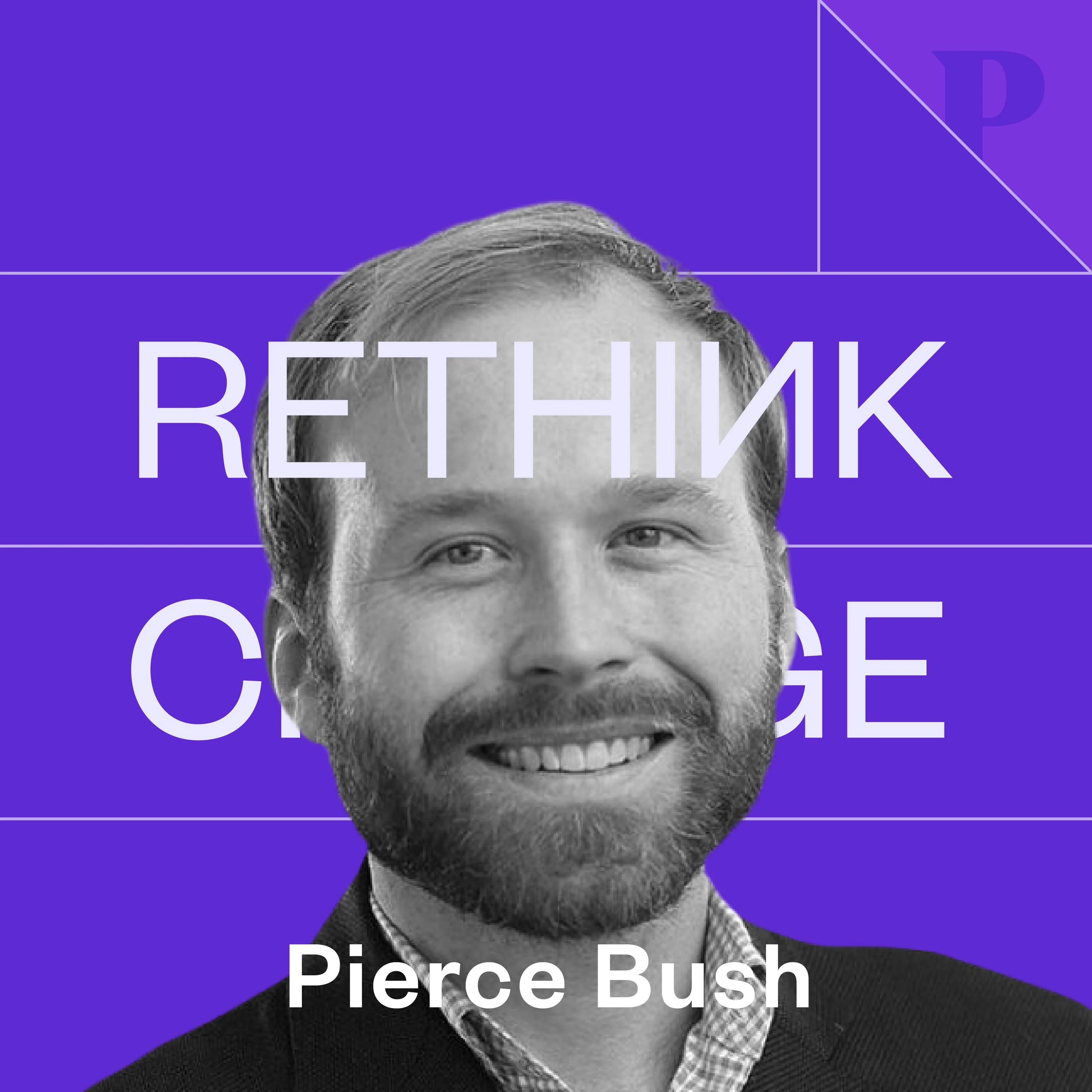
23 — Heart-Led Leadership: Why Mission and Values Come Before Systems with President and CEO of Big Brothers Big Sisters Lone Star
Navigating financial strain, organizational change, and the isolation of leadership demands courage and clarity. The strongest leaders pivot quickly, stay grounded in their values, and act rather than wait for circumstances to shift.
Shownotes
Things to ponder
Navigating financial strain, organizational change, and the isolation of leadership demands courage and clarity. The strongest leaders pivot quickly, stay grounded in their values, and act rather than wait for circumstances to shift.
Growth often emerges in seasons of pressure, when optimism, resilience, and strong relationships become essential tools for navigating the unknown. Our guest this week shares how these exact principles shaped his leadership journey. In this episode of Rethink Change, Hosts Matt and Ward chat with Pierce Bush, President and CEO of Big Brothers Big Sisters Lone Star.
Pierce Bush is an Experienced Chief Executive Officer with a demonstrated history in non-profit organization management, with skills in Organizational Leadership, Open Book Management Systems, Fundraising, Business Development, and Team Building. Pierce is also a strong results-oriented professional with a BA focused in American Studies from The University of Texas at Austin.
Throughout their conversation, Pierce explains that leadership starts with heart, values, and mission, long before systems or processes come into play. He reflects on how his early experiences as a volunteer shaped the way he leads today, emphasizing that clarity of purpose is the anchor for every decision.
From unifying fragmented teams across Texas to stabilizing an organization facing serious financial strain, Pierce shows how values-first leadership creates alignment even in moments of uncertainty.
He also discusses the importance of empowering staff with information, embracing transparency, and simplifying complex missions into language anyone can understand. His approach highlights how a clear, consistent message not only strengthens internal culture but also helps donors and volunteers see themselves as central to the mission.
- Resources
- Find Pierce on LinkedIn
- Chapters:
- 00:00 Intro to Guest: Pierce Bush on Becoming a Big Brother
- 04:06 Transitioning from Volunteer to CEO
- 09:31 Implementing the Great Game of Business
- 15:17 Navigating Major Changes and Building Consensus
- 17:20 Reflections on Leadership and Mentorship
- 20:04 Conviction, Challenges, and Values in Nonprofit Leadership
- 21:06 The Great Game of Business
- 24:42 Communicating Value to Donors and Simplicity in Messaging
- 28:05 Empowering Donors and Volunteers and Lessons Learned in the Nonprofit World
- 35:38 Final Thoughts on Looking Forward to New Challenges and Gratitude
Transcript
[00:00:00] I think values and culture are by far the most important rules a leader has. So much of kind of negotiation is just making the other person feel validated and heard every turn of trying to create action. That is a vital, vital part of my leadership role. The power of having a network of people that are in your corner that you can bounce ideas around with is just so important for any leader. ' C ause leadership can be really lonely.
Matt Pennebaker:[00:00:23] Today on Rethink Change, we're joined by Pierce Bush, a visionary leader dedicated to empowering young people in the strengthening communities with over a decade as CEO of Big Brothers big Sisters, lone Star Pierce has guided the organization to become the largest in the country in terms of children served, making a meaningful impact across Texas. Pierce, welcome to Rethink Change. So Pier ce , I think for starters, it would be good to give a kind of the clip note story of how you even became involved in Big Brother, big Sister, and what that shift looked like into ultimately running the, the organization in Texas. I,
Pierce Bush:[00:01:10] I never dreamed I'd actually be the CEO. I'm a Big Brothers Big sisters entity. When I was in college, there was a, a, a female friend that I had who one night when I was out, you know, we were talking about what she did earlier that day and she said that she spent time with her little sister and she said, you know, come to think of it, you would be a great mentor. You should think about signing up for Big Brothers Big Sisters, you know, big Brothers Big Sisters is very intentional about creating matches that last a long time and our outcome shows that actually matters. So I called the Austin Agency, I was very. Flattered that she thought I'd be be good at it and asked them, can I sign up? And they said, if you know you're gonna be in Austin, you should, you should sign up then. So I didn't. I ended up moving to Houston, um, after college and once I knew I was gonna be in Houston, I signed up. My expectations, Matt, at the time was that I was going to naively help a kid and, um, and go to college. You know, we went to a school not where. A hundred percent of our classmates go to college, for example. And I knew that we were, you know, we were very blessed and we came from unique circumstances. University of Texas showed me that kids come from lots of different circumstances, and I thought naively, I would help a kid go to college and be the giver. When I signed up to become a big, I met Jalen, my little brother for the first time I took him to the zoo. She was six years old at the time, which was the, the youngest. We let kids in the program. It's like, take Jill to the zoo. And I realized I was naive and thinking I would be the, the, the guy that kind of contributes to the relationship with a very simple, simple but kind of funny anecdote. So I'm. Taking jail in there. He thinks I'm really his brother. He is asking me all these questions like, purist couldn't pronounce my name. If you go bald, are we still gonna be brothers? And all these kind of interesting questions like that. Wish I was a little 22 or 23 at the time. And we get to the zoo, I hand him his ticket and he walks up six years old, kind of a pitch squeak of a kid. He walks up to the ticket counter lady and says, I know what you're thinking. I got real good looking eyebrows, don't I? And I realized I was gonna get. Pick advice from this guy, single dude at the time. And, uh, as fate would have it, you know, this mission has given me so much. Matt, I signed up as a volunteer. I got a lifelong brother in Jalen. Jalen in February will be turning the age I was when I met him. So I've known him since 2009, if you can believe that. He's just an incredible young man who's gonna always gonna be a part of my family. And I interestingly did meet my wife through this program. She was a volunteer. I just feel like there's the. I believe that to be true. When you sign up with kind of pure intention, wonderful things can happen. If you kind of want to sign up and give of yourself, you know, you always get 10 x at least back, and Big Brothers, big Sisters. For me, it's been a hundred x probably my, my whole family, my career. All of this stems from this, this conversation in Austin with a young woman encouraging me to sign up to be a big and what an awesome, you know, journey It's been.
Matt Pennebaker:[00:04:02] You sign up, you meet Jalen, you ultimately meet your wife. How did you end up transitioning into working for the organization itself?
Pierce Bush:[00:04:11] Yeah, so for three years I was just a volunteer. So through from 29 or 2009 to 2012, and it's just a volunteer, you know. But I was taking Jalen to very interesting things that I thought could benefit the agency. So for example, I would go to the owner's box at the Texans with my grandparents, and Jalen would come and the McNairs were there and I was like, send me. We could get The brothers sisters was more involved with the Texas, and I would tell my math support specialist this, it really required persistence. Uh, Matt, this is something that I just heard when I came to work for the agency, but there was really this firewall between our program people just focused on the program and then the development people, and they wouldn't speak about. What was going on in programs. So my ability to help and try to provide value to grow the mission was never really passed on. That changed in 2012. I was asked to speak at a, at a board meeting and be what they call the point of light. So just talk about my mission. Jalen came with me and they invited me to join the board. I was a board member for about two meetings and then I got asked kind of out of the blue, and I knew this job existed, but if, if the president. Uh, of our organization. Hadn't asked me. I don't think I would've applied for it, which is interesting because it felt so purposeful once he threw it out there. But he kind of called me and invited me to be a staff member, not as the CEO. So I was hired as a development guy, and then it was clear that Houston Chapter Inberg was five other agencies around Texas, and you could tell that all of those. Had created actual weakness. They weren't done well. Culture was not thought through. Systems were not thought, thought through to make sure that our, our local work was met with local program leadership, et cetera. And so we saw this failure actually in, in our business, where we were losing a million dollars to $2 million a year, and all of that came to a head. In 2015 when the CEO, you know, before me was kind of pushed out and the C position was open and a mentor mindset said, Pierce, you really have a clear vision for how this could be better structured. How to create an enterprise, big Brothers, big sisters agency, that maximizes kind of the efficiencies of scale of being one entity that has the right. Things that that should be locally controlled and local hands centered around kind of shared values and shared systems. And so that embarked my tenure year, which in August I just spent my 10th year as CEO and, and really I'm really proud of what we've accomplished over that time.
Ward Pennebaker:[00:06:30] You said that there are multiple cultures, I'm sure there are issues in terms of, uh, one city saying, I'll run everything. And other city saying, I'll run everything or I'll tell you what to do. And so you came into what would. Ly be called a somewhat dysfunctional corporate organization. Yes. How can you go about kind of hammering that out and how did you build a culture that would work between all those entities?
Pierce Bush:[00:06:55] Yes. I mean, and that's well said. I can't, I, I still have kind of nightmares to some of my early conversation. I remember the first day I was CEO, I flew up to Dallas. I knew. We have under one month's operating cash, maybe half a month's operating cash in between our entities. We have two legal entities that I kind of control, which basically means we're, you know, we're worried about payroll, we're operating at over $1 million a month. I fly up to Dallas, kind of give this pitch. I was 29 years old and I could see some of the Dallas people were like, who the, who's this kid? Like, I can't believe this kid got this post. And, and so I kind of made my spiel and first question I got was, when are we gonna get pay raises? And that was such an eye-opening. I'll never forget that question because prior leadership ward. A desire, I think, to, to protect. The staff had not been transparent, first of all, about, you know, how dire the situation was. They thought they were protecting the team. Really, they were doing them a disservice. By the way, your A players will opt out of scenarios like that. Because they, they're smart enough to understand leadership doesn't get it. I need to go do something else. This is running outta money, but you have a lot of people that just were kind of limping along with the organization. Now, I wish I did this differently in hindsight, but the first thing I did was really try to get a grasp of our systems and pushed that out to empower people. The second thing I did was redid our values. I wish I did that backwards. I wish we really, I think values and culture are by far the most important. Schools a leader has, and again, I kind of went systems first because it felt most urgent because we needed to, you know, to, to rebuild our coffers a little bit. But again, if I could do it again, I would've done, I would've done values first. In hindsight, it all worked out. Just to be clear, I'd still say values, kind of Trump system and making sure, to your question, were, you know, people in Abilene, Texas, in our Abilene office had a whole different idea of what our culture was, the people at Houston, if that makes sense. And that went down. Through the systems as well. But I would say systems is what I did first. Then culture and values. I wish I did it backwards in hindsight,
Matt Pennebaker:[00:08:59] Y eah, that, that's such an interesting point. I think that's reflected in the culture when you say, I mean here you are, you're operating on less than one month's worth cash flow, and so you're worried about keeping the lights on and you've got people saying, when am I gonna get my next raise? That is such a disconnect. Culturally between the organization's mission and the self-interests of, you know, specific individuals, how'd you overcome this notion of, I gotta get everybody on the same page? We gotta get aligned with where we stand financially and who we're as an organization, where we're going.
Pierce Bush:[00:09:31] I think one of the hallmarks of my, of my leadership, if I were to say this is, and I used to think this was not original. But really finding out what works in other enterprises and bringing it to us has been a hallmark. That has worked very well. There was a small agency at the National, my first National Big Brothers Big Sisters conference, that one Agency of the Year, and they were describing how she, you know, fully empowered her team and. All of the numbers of the organization. And I rushed up to her after she received this award, and her name's Katie Davis. And I said, Katie, what do you do? And she said, we operate a system called The Great Game of Business. It was a system devised by Jack Stack. He, by the way, devised it for a very kind of boring manufacturing business, but that was also. Kind of on dire financial terms and real, he realized that everybody's gonna lose their job if they didn't turn this around. And essentially the symptom, I mean, there's nothing novel about it at the end of the day. It creates scoreboards that everybody can understand and everybody has all of the information even before I do as the CEO. So unlike my first day of CEO where people said, when are we getting raises? And they didn't realize we were running outta money. Now you walk in to our office and frankly, everybody will have that information before I do. And so we've been operating with this fully transparent, open book management type system since 2018. We have not lost money one year where we were going from losing $2 million a year, a million and a half dollars a year prior to my becoming the CEO. What that has also done, Matt, is it's. It's freed me up to be far more strategic in my time. 'cause I know that these small things that I used to have to always question are being covered by the team because we incentivize them to hit our, the program goal first, which is why we're here. We're here to impact more kids as a nonprofit, but also we need the money to do that to, to hit incentive, you have to have a net income above what you spend. And by the way, one of the easiest ways to drive a net income is to not spend as much. On stuff that doesn't provide value. It doesn't actually have a an ROI. And so it's just amazing when you can activate an entire group of people, empower them with all the details, unleash them to, to be owners in the mission, which again, we're nonprofits and nobody owns it as a stock, but that, but they own it as we are gonna win as a team or lose as a team, what can happen. And that system also unified this enterprise organization because it created p and l ownership. At each of my, what we now have is five markets that rolls up seamlessly into the central organization. So we have essentially five market scorecards and then a lone star wide scorecard that is reflective of how, you know, how the ship is doing as a whole. And, um, it's really, really worked well for us.
Ward Pennebaker:[00:12:11] Can you give us an example, a specific example of you institute the big board? Yes. And where all of a sudden. You're finding that people would say, well, you, you tell me they would come forward with ideas of where to save money and how to work better, et cetera.
Pierce Bush:[00:12:28] First of all, it used to be Ward. When I became the CEO to kind of a question you asked earlier, we would hire a position in Houston, which had financial health. Nobody knew it, but I knew it because I was on top of the numbers. And somebody in Abilene for example, would say, wait a second. That's unfair. They got that position. We should have that position. I'm like, you guys are, are like a $200,000 deficit for organization. Like that just just doesn't make business sense. If you want that position, like, yeah, let's go find the money and do it, but Houston money, you know, United Way of Houston for example, they just that by their charter, they wanna support our programs in Houston and every funder across Texas identifies with that. So a specific example worked to your question that I can think of is. On positions. I never have to question if a position that is being filled is really needed, because people have thought, Hey, is there a better way to do this? Now, occasionally light questions need to be asked, but really it's a much more intuitive process because there's, you're introducing self-interest into the team atmosphere of are we winning together? When you're at a position and you don't think, is there a better way to do this? It, it adds a cost. And so this, this model naturally drives efficiency. Another example I can think of is just in some of the, the kind of cross team collaboration. You know, we had a donor this year who will remain anonymous 'cause he requested to, but very generously gave a million dollar donation in honor of his. Late wife who he met through Big Brothers, big Sisters, interestingly, in the mid 1980s, and it was an incredible gift. This gentleman, he's still very close with his little brother, which as how he got engaged with the program, they've worked together at this company that, that this gentleman and his wife started together, but they lost touch with the wife who just died tragically and subtly this year with her little sister. Well. Our team is now so self-motivated, align with our values. One of our values is honoring relationships. Another one is being driven to action. But because of this great game, they saw that million dollar donation hit the board, and they went out on their own volition without me suggesting it, and were able to track down this long lost little sister. By the way, what a gift to this gentleman. He, I mean, he has, it's been two decades since he saw her, you know, now he's reconnected with this former little sister of his, of his late wife. And he shared with me a message that she said about how this deceased big sister caught her and showed her what a real family looks like. And now this lady, you know, lives in north Texas and has a family. She has six kids, happily married, and it's just the full cycle. Of our program and she credits that to her big sister. What a beautiful moment. What a, what an awesome thing our team could do to add value to our, to our donor's life. And again, the big board kind of brings these ideas to life in a very intuitive way where it doesn't have to just be the leader's idea to go do it, if that makes sense.
Ward Pennebaker:[00:15:17] You've been through lots of twists and turns in your time there that involve big change. Tell us a little bit about some of the. The major ones that you came across and how you navigated them?
Pierce Bush:[00:15:27] Yeah, I think leading a nonprofit, it requires a lot of listening. Ward, you're very active in the community and so you know this, you know, and it's, and it's funny in some ways because nonprofit board members, for example, don't get paid, but they, they have lots of opinions and I found that that, that it's really requires legislative leadership skills more than executive leadership. But I do think that that's actually a really good way to run a business as well. In other words. You try to build consensus towards the vision of where you need to go. It's vital. In a nonprofit, it's actually a better way to run a for-profit business too, I believe. Although in a business you can run it much more top down, right? Because of whoever has the gold controls, how things go, as they say. But yeah, I, I think back to when I first became the CEO, we had this terrible building in Irving that had no purpose for our organization. In fact, it had debt on it. I mean, it had three plus million dollars of debt. There was a lot of passion that this building was the, the best thing since sliced bread for our mission. There was no signage. It was in Las Colin as you would drive by, not even know you were passing our building. And the debt was eating up our reserves in one of our, in our foundation entity because it was, you know, it was a heavy note to pay and it's really hard to go retire debt. And so the idea of getting. People on board with, with selling this. It's something I'm really proud of 'cause it was the right business thing to do, but that required going, especially to the people that were most passionate about it being good and listening to them and making them feel heard. Some of those people opted out. Some of those people came along. Because they felt heard. People just, I've learned in this, in this leadership position, and Chris Voss, the FBI lead negotiator, wrote a great book called Never Split. The Difference talks about this. So much of kind of negotiation is just making the other person feel validated and heard. And so I, I have found that at every turn of trying to kind of create action that is a vital, vital part of my leadership role.
Matt Pennebaker:[00:17:20] Pierce, you've obviously been very successful in the role and it's been a decade that you, you've been in place, but you came in to CEO at one of the, if not the largest, uh, division of big brothers, big sisters in the nation at 29. At what point there's gotta be a sense of imposter syndrome or, you know, holy shit, I'm in over my head. Was there any sense or a specific story that you can recall that's just a, a kind of learning by fire situation?
Pierce Bush:[00:17:46] Yeah, I mean, I remember Matt again going up to Dallas the day I was gonna be introduced. 'cause that's technically where the headquarters was. And I've lived in Houston this whole time and walking out of the southwest. You know, jet Way. I, I feel like I knew in a way that the board might mean not, didn't even understand just how dire the financial situation was, and that was really stressful. I, I had never laid off anybody much, much less, made a very difficult decision to lay off a percentage to kind of protect the whole, but those things you just have to push through as what I've learned. And again, as long as you. Operate with a sense of values that you can be proud about and really test out all of your decisions against those values. You can land in a really, in a really favorable spot and make tough decisions a lot easier. And so I would say I, I know this sounds cliche, but you know, I had some incredible mentors that walked alongside me, particularly in those early years. One was a guy named Steve McDaniel, who became my board chair pretty quickly, and he, you know, was a seasoned business executive who. I've faced his own trials and tribulations in his career, but provided incredible sounding board to me and gave me a little bit of courage when I needed it and encouragement. And so I think the power of having a network of people that are in your corner that you can bounce ideas around with is just so important for any leader. 'cause leadership can be really lonely. The other thing is, Matt, I still, you know, as I'm now winding down my tenure, I, I'm really proud of what we accomplished and it is kind of fun, by the way, to, to retire from a job that you've done for a long time while you're still alive. ' C ause it does feel a little bit like a, you know, obituary, like you're going to your own funeral and you, you're hearing all these people say nice things occasionally though, you, you hear people, you're like, I don't think they understand what we did. And again, that's okay. Is what I've had to internalize. It's really more about internal locust of kind of expectation than external. Because leadership, you're not gonna win over everybody all the time. I decided earlier this year to read Bible. I think it was very well timed cover to cover. And if you go back to Exodus, even Moses performs all these miracles with God's help. And people quickly forget all the good that happens and they start complaining. And the wilderness, they wanted to go back to Egypt for slavery, you know? And it's just such a fascinating condition of the human condition is you can't do it for the accolades. That can't be your purpose. It has to be because you're convicted that you're doing the right thing, you're focused in your values. And again, as a 29-year-old, I learned a lot of lessons that just all carry with me my whole life. 'cause these were, again, people think running into nonprofit is easy. It's really not. It's a double bottom line business that requires. A sense of fortitude to, to kind of push forward on program objectives that also make sure the fundraising's done. And those are two separate strategies that, that really need to be ma cared for, um, diligently with equal attention, if that makes sense. And it's not a lot of businesses, if you take care of your customers and you crush it for your customers, they will likely come back. You could probably over time raise the prices on them. Our volunteers and our littles don't pay for our services. It's really our donors, and that's, they're completely separate, if you think about it that way. That's a complex aspect of running a nonprofit that I think a lot of business people struggle with when they do make that leap over.
Matt Pennebaker:[00:20:59] So clearly it's an an incredible challenge, different dynamics than a for-profit organization deals with. You know, you and I talk pretty frequently and one of the things that really was a profound impact on us was this great game of business concept. In fact, it was so, such a profound impact that we rolled that out internally at Pennebaker as well, and it's been incredibly, incredibly impactful for us. It's easy to have open finances when you get a million dollar donation here and there . It's incredibly hard. To have open financials when the times aren't good. Can you talk through what that was like? Especially in the early days when you had rolled this out and it was dark skies and gray clouds.
Pierce Bush:[00:21:46] Yeah, I, you know, Matt, you're right. And I even see this 'cause of how we run it with five markets. My markets are all, even today, are in different places on the fight, on the big board, on their. On their mini boards of the big board, if you wanna call them that. And it is a test of leadership. It's easy when times are good. One of our markets is just crushing it this year. And so of course, every time we discuss their numbers, it's just like celebration and success. It's a lot harder in our mar one of our markets, which is a big market that really hasn't done anything wrong. But has been disappointed by a few funders that pivoted their funds because of the government funding issues to the groups that are kind of clutching their pearls over not getting funded and all those types of groups, and they've redirected funds That would've gone to us to fund those groups. And we've taken some big hits in that market because of that, for example. But I still land on the side of, I think that people. Can make better decisions when they know, even when times are tough. But part of that is the leadership of really casting that vision, communicating well on what you're gonna do to overcome those dark clouds, if you will, and always seeing light at the end of the tunnel. You have to, as a leader, no matter how hard it is. Convey a sense of optimism that you see the light at the tunnel even. Even if it's a little bit of faking it until you make it. Matt, again, I would say it's best to genuinely strive to where you see a little bit of that light peaking out, but casting that vision that we're gonna get through this is so important. And then pivoting. If you're way over your skis on finances, you might have to do your business a little differently, but through change comes sometimes. Very positive redirection. You know, sometimes you kind of just do things the way they are because there's no need to challenge it. And you know, I think about Ward, something you taught me years ago when we were there was an oil and gas downturn, and you were saying, look, what I tell our clients is, you know, during every downturn, this is when business market share changes hands. This is opportunity if you seize it. And that's true. I think when, when there's challenge, there can be great opportunity. You have to vision, you have to, to envision it as such and, and redirect how you think about it, if that makes sense. And then try to get the team to be, to see it in a similar way. And again, that's actually warism. I'll never forget having a cocktail award. And [00:24:00] I was like, oh, I'm gonna now not be as worried about our, that was when I was just running Houston Fer Oil and gas funded here, our market is, and I said, I'm gonna use this as a time to go after market share and to increase our funds and our partnerships. And it was, it was spot on Advice. The worst thing you can do. And it speaks to kind of ward's advice is what Warren Buffet calls thumb sucking. You see a problem and you don't do anything about it. He and Charlie Mugger used to call it thumb sucking. You just sit there and you, and you hope that the situation changes. I think any ability of a leader is just kind of seize the challenge, see the positive in it, and try to try to convert your business in a way that activates that positive for, for the good of your business basically.
Matt Pennebaker:[00:24:41] That's great insight. So one thing that I want to pivot to Pierce is, you know, you talked about the opportunity, you know, there's always opportunity in downturn. That's where you grab market share. Um, in your world, a lot of the, you know, it's basically fund fundraiser driven and there are a lot of nonprofits out there. There are a ton for these donors to choose from. Yes. And so I think are clearly articulating the value of what Big Brothers Big Sisters is, what it stands for and why to donate. BBBS talk through some of those challenges and the struggle of articulating why you over the next 4, 5 0 1 C3?
Pierce Bush:[00:25:16] Well, first of all, Matt, we've, we have worked together with Pennebaker on this and I, I've been very grateful for those, those projects over the years. So, so thank you to that. I, I would say it's so clear. 'cause you're right, there's a lot of noise, there's a lot of options. Ultimately this is a marketplace and it's a competitive marketplace. And I think one thing that people do wrong. Not to start with that, but is they try to sell the complexity of a mission. Ultimately, big Brothers Big Sisters has a beautifully simple mission and we have real outcomes. And the key thing I have found is you view it as a scale of one to 10 of messaging complexity. Most people try to sell, say 10 is the most complex. Most people try to sell at a six. People really buy it. A one, two, the simplest kind of caveman theory of messaging, and it almost feels too simple sometimes. So people try to add complexity unnecessarily into their own detriment. When when you're out there and talking to a donor, first of all, you have to also realize, yes, you're soliciting funds, but you're also giving them purpose and you're giving them. Something that's intangible, particularly your high net worth funders. Look, I know a lot of people that made a lot of money but aren't terribly happy and that, you know, list list with their vast resources, what we give them as an opportunity to really meaningfully benefit the lives of others. And at the end of the day, that's, I mean, that's what we're wired to do in my opinion. Is to make a positive impact to help others to make the world a little bit better of a place. And, uh, and we provide that. And so I try to make sure our fundraisers go with confidence, knowing that our mission is worth making me asking that we're in some ways, while yes, we're very grateful for the funds that come our way, and we lead with gratitude and we honor the people that support us, but we're also providing them something meaningful at the end of the day to, to lead with that confidence. So it's simple message. It's confidence, you know, it's speaking to the outcomes in a clear way where people understand it. All those things lead to success, in my opinion, but mostly it's going out there and just doing the work and not thumb sucking. When times get tough, that's the worst thing you can do.
Ward Pennebaker:[00:27:20] It's interesting you mention about the simplicity, because we've always. Then if you have to explain what you do to a 7-year-old, you can't use all the $64 words and all the high pollutant concepts. You gotta distill it to what is the essence of what you do. And people don't like to do that because they think it makes 'em sound less important. So I That's more complex. The sound more important.
Pierce Bush:[00:27:43] Yeah, it's, it's exactly right. And it's the wrong, it's just the wrong thing to do. 'cause it gets, it gets lost in the noise. I have learned in my tenure that if, if whatever you say kind of leads to other questions being asked and that in a way where you can tell you've confused them, you've already lost them, hit that point. And so. You know, it sounds so simple, but really you want people to just follow a very simple script. I also think another kind of attitude I, I've taken is Big Brothers, big Sisters are not the hero of the story. I'm not the hero of the story is the leader, the, the hero of the story is. It's the donor that we're trying to engage or it's the volunteer that we're asking to give their time. We are kind of a guide for them to, to live a life with deeper purpose, but always positioning our materials around. Yeah, it's not Big Brothers Big Sisters that's shining. It's you who's gonna make this possible by giving of your treasure. Or your time. That to me is again, where I think a lot of brands get it. They think they need to be the hero of the story to get the donation. No. The people you're engaging need to be the hero of the story. No, I think you're, you're exactly right. At what point did you realize that? I think intuitively, Lord, I probably always. Don it. You know, I think back to successful presidential campaigns, you know, if you even look at the lingos around that, when, you know, when my uncle, for example, ran, ran for precedent 2000, not to bring that up on the podcast as a random point, but his line was together. We can't hun those pull demos. I, you know, but together we can't. It's not about what he's gonna do for you, it's about what? Together, we what we can do, right? Ronald Reagan. Now Donald Trump's Make America great again. You know, it's just such simple, it's just such simple ma messaging in, in terms of Big Brothers, big Sisters. When did I learn that the brand, the company can't be the hero? I, you know, it's too trial and error. You learn all this stuff. You see it when you're selling it, and it's too complicated that you've lost the person. They ask some questions and now you've, you've lost them. But I think intuitively. Again, if you kinda lead with the heart of this isn't about me, this is about the people I'm interacting with, you'll always get a better result. And so I don't know, I, I don't know if there's a specific moment Ward where I got better at that or I more clearly realized it, but it certainly is true in my opinion. What you've learned in the
Ward Pennebaker:[00:29:54] nonprofit world certainly translate to the for-profit world. And what would you tell somebody who's taking on leadership of a a for-profit? What kind of tips would you give them?
Pierce Bush:[00:30:06] I would say. One, always lead with values first and make sure they're not on a wall. We have incorporated a system here to take, to extrapolate our, our values into a, a culture of, of excellence, but our vision is to be the premier mentoring organization in the world to be known as that and to make that true. We have a, a, a set of 16 non-negotiables award that we, our team meets three times a week to go over three of the different non-negotiables and to highlight stories and to highlight other, their colleagues when they spotlight these non-negotiables in action. We took that from. From Horse Schultz, who founded the Ritz Carlton? What? What? What does the Ritz have to do in common, but Big Brothers, big Sisters? Well, not much except for the fact that we're both in the service industry at the end of the day as of most companies. Okay. So having a real culture of service excellence and aspiring to excellence. People, I would say anybody in the for-profit world, why would you want to be mediocre? People wanna be part of a team. That's, that's number one. They wanna be excellent, so, so call people to that. Again, I'm very biased towards the great game of business and transparency. You know, the wealthiest guy in Houston, Jeff Holder brand, operates a private business off the great game of business or the big board, if you wanna call it that. Uh, Netflix. Very profitable, publicly traded company. You know, Reed Hastings wrote a book called No Rules Rules. I read the book and I was like, this makes no sense. They have to have a system like the Great Game. Sure enough, chapter nine, he talks about the great game of business and how that allows them to have this culture. People are truly empowered to pivot and make really quick decisions organizationally, but it all ties together through this very transparent system where everybody knows where they stand and they give For a publicly traded company, they give, you know, managers and all these people that probably aren't given in most publicly traded companies. A lot of information. They basically say, look, we trust you as leaders in the company with this. If you go insider trade off this. We will report you to the SEC and you'll go to jail like we will. So we're trusting you with stuff that should not be exchanged. So I'd say the for-profit, any for-profit should use a system like that. And then really, again, just, just, I think communication is vital in any leadership role and having a, a, a system that, that again. Especially when you face problems, you know, Lord takes your advice. Use that as opportunity. Problems will come. It's part of life and some aren't pleasant, but everybody has the, the ability to truly determine how they respond to that. And if you kind of can view it word, which you taught me, I, I really mean this when I say it. You taught me this when I was like 27, you know, right before I became the CEO 28 27, that anytime that there's market challenge. That's opportunity. That's when people change, market share. It's not when times are good and, and that's not, that's it's, it's actually much easier. You taught me to differentiate yourself when times are tough and so it's really good advice. I think any for-profit leader should take that advice to heart. So
Matt Pennebaker:[00:33:08] Pierce, you'd mentioned earlier at the start of this episode, not necessarily a failure, but a potential regret of you wish you had tackled values before you dealt with processes. And so I'm curious, a lot of the, a lot of the listeners are either leaders or emerging emerging leaders to this podcast. Did you experience any failure or regret that really changed the way you think about leading? Going forward.
Pierce Bush:[00:33:35] I mean, of course early on when we were trying to decentralize and I was creating this market model and hiring my first market presidents, I made some mistakes on hiring. And hiring is really tough. And again, it goes back to values. And that's why I would put the values first, because I think if you have clear set of values that aren't just living on a board. Really kinda living, breathing aspects of your, of your mission or your organization. You can hire and make sure that those values are gonna be understood from the get go and left out. And I think that makes the hiring process a little bit easier 'cause you could kind of test people against how they might carry out or live into those values. So yeah, that, I mean, I've made lots of mistakes as I think any leader does. The key thing is not to, to worry about, I'm give them stick. It's the ability to. To court Correct and change. Be okay. Changing your mind. You know, one of the faults in our political system is anytime somebody changes their mind, you call 'em a flip-flopper. Well, if you get better information, then you're foolish not to change your mind, you know, and, and that's part of leadership is to not, again, be stuck in a position where your thumbs sucking and you're idle and you're not taking action. But it's to be able to, to, to, to make decisions and then be able to pivot and correct them if they're wrong. I mean, there's numerous examples, Matt, of that, of that happening of us maybe going to do a assist. You know, we switched to a Salesforce platform for our donor database and it was, we spent a little money on it and it proved to be not as seamless as we thought we went. We just went back to our other deal. We didn't just go do it because we, you know what I mean? Like the cost of kids staying committed to it actually would've been greater than just going back to the system that we thought we were gonna prove upon, which actually was better. You get my point. I think mistakes are part of it. It's really how you respond and how you use your vision and your values to navigate through them all.
Matt Pennebaker:[00:35:18] Don't be afraid to fail. Don't suck your thumb.
Pierce Bush:[00:35:19] Pivot quickly. Yes. Yes. They have values. Have values, exactly.
Matt Pennebaker:[00:35:27] So Pierce . So we always ask, is there anything that you wish we'd asked? We didn't ask or that you thought we would've asked?
Pierce Bush:[00:35:34] Not really. I, I look forward to testing ward's idea though, on the for-profit. 'cause as you guys know, I'm, I'm planning on handing over the helm of Big Brothers, big sister, CEO position and moving back into the for-profit sector here at the end of the year. So I'm really excited to test everything I just told you guys in a for-profit setting. Um. Maybe you'll have to have me back on in two years. So we could say, how did it all, how did it all, how did you, how did it go? But no, I'm really, really proud, Matt, of what the 10 years and even the three years before I was, the CEO have been. It's been an incredibly valuable part of my career. And again, I've been so grateful to compare notes with leaders like yourself and Ward as I've gone on this journey . Again, I'd say that one of the hallmarks, and actually I read this in a book called Made in America by Sam Walton, and I found this to be very, a very humble thing of him. He wrote it right before he died. Uh, but in the intro, he thanks all of his competitors. Basically, he says, I didn't have one original idea. I got this from Kmart. I got this from, you know, some other big box retailer. And again, I think it's okay. To have mentors, to learn from others, to apply those to your enterprise. I think that those are very, very valuable lessons. And again, I know, I know that Maker excels at helping create some real guardrails around businesses that help them focus and keep things simple and, and I value that that helps them gain market share. So I think people, you know, would be a lot better off if they. If they partner with pit baker.
Matt Pennebaker:[00:37:04] Well, I I appreciate that.
Ward Pennebaker:[00:37:05] Yeah.
Matt Pennebaker:[00:37:06] I'm somewhat biased. Well, Pierce, uh, it's just been such a joy to have you on. You're so compassionate just in life. You're so successful at, at everything you've done. This has been a really fun episode.
Ward Pennebaker:[00:37:20] Exceptional, exceptional, Pierce. Thank you so much. Thank you guys.
Matt Pennebaker:[00:37:22] Thanks for listening to Rethink Change. If you enjoyed this episode, please share it and be sure to follow the show so you don't miss a single episode. If you're a disruptor looking to challenge a status quo and don't know where to start or what to do next. Penn eba ker can help find out more at pennabaker.com.